

1.000 Mph In Si Units
 | This page uses content from the English language Wikipedia. The original article was at SI. The listing of authors can be seen in the page history. As with the Units of Measurement Wiki, the text of Wikipedia is bachelor nether Creative Commons License run across Wikia:Licensing. |
The International System of Units (abbreviated SI from the French language name Système International d'Unités) is the modern form of the metric system. It is the world's most widely used arrangement of units, both in everyday commerce and in scientific discipline.
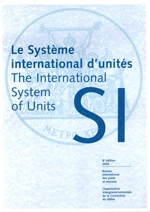
Encompass of brochure The International System of Units
The older metric organization included several groupings of units. The SI was developed in 1960 from one of these, the meter-kilogram-2d (MKS) system, rather than the centimeter-gram-second (CGS) system, which, in plow, had many variants.
The SI introduced several newly named units. The SI is not static; it is a living set of standards where units are created and definitions are modified with international agreement as measurement technology progresses.
With few exceptions (such equally draught beer sales in the U.k.), the organisation is legally being used in every country in the world, and many countries exercise not maintain official definitions of other units. In the U.s., industrial use of SI is increasing, but pop use is even so express. In the United Kingdom, conversion to metric units is official policy but non yet consummate. Those countries that withal recognize non-SI units (e.thou. the US and UK) accept redefined virtually of their traditional, not-SI units in terms of SI units.
History [ ]
- Run across principal articles: meter, kilogram, second, ampere, Kelvin, and candela.
The metric system was officially adopted in France after the French Revolution. During the history of the metric system a number of variations have evolved and their use spread around the earth replacing many traditional measurement systems.
By the end of Globe State of war Ii a number of different systems of measurement were nonetheless in use throughout the globe. Some of these systems were metric system variations whilst others were based on the Imperial and American systems. It was recognised that additional steps were needed to promote a worldwide measurement system. Every bit a result the 9th General Conference on Weights and Measures (CGPM), in 1948, asked the International Committee for Weights and Measures (CIPM) to conduct an international study of the measurement needs of the scientific, technical, and educational communities.
Based on the findings of this study, the 10th CGPM in 1954 decided that an international system should be derived from half dozen base units to provide for the measurement of temperature and optical radiation in addition to mechanical and electromagnetic quantities. The vi base units recommended were the meter, kilogram, second, ampere, Kelvin degree (later renamed the kelvin), and the candela. In 1960, the 11th CGPM named the arrangement the International System of Units, abbreviated SI from the French name: Le Système International d'Unités. The seventh base unit, the mole, was added in 1970 by the 14th CGPM.
The International System is now either obligatory or permissible throughout the globe. It is administered by the standards organisation: the Bureau International des Poids et Mesures (International Bureau of Weights and Measures).
Units [ ]
- Principal articles: SI base of operations unit, SI derived unit, SI prefix
The international organisation of units consists of a fix of units together with a set of prefixes. The units of SI tin can exist divided into 2 subsets. There are the seven base units. Each of these base units are dimensionally independent. From these seven base units several other units are derived. In addition to the SI units at that place are also a prepare of non-SI units accepted for apply with SI.
| SI base units | ||
|---|---|---|
| Name | Symbol | Quantity |
| kilogram | kg | Mass |
| 2d | s | Time |
| meter | thousand | Length |
| ampere | A | Electrical electric current |
| kelvin | K | Temperature |
| mole | mol | Corporeality of substance |
| candela | cd | Luminous intensity |
A prefix may exist added to units to produce a multiple of the original unit. All multiples are integer powers of ten. For example, kilo- denotes a multiple of a thousand and milli- denotes a multiple of a thousandth hence there are one thou millimeters to the meter and one thousand meters to the kilometer. The prefixes are never combined: a millionth of a kilogram is a milligram not a microkilogram.
SI writing fashion [ ]
- Symbols are written in lower case, except for symbols derived from the name of a person. For example, the unit of force per unit area is named subsequently Blaise Pascal, so its symbol is written "Pa" whereas the unit itself is written "pascal". The one exception is the liter, whose original abridgement "l" is dangerously similar to "1". The NIST recommends that "Fifty" be used instead, a usage which is common in the U.S., Canada and Australia, and has been accepted as an alternative by the CGPM. The cursive "ℓ" is occasionally seen, especially in Nippon, but this is not currently recommended by whatever standards body. For more information, encounter Litre.
- Symbols are written without grammatical markers when used with singular numerals: i.e. "25 kg", non "25 kgs". Pluralization would be language dependent; "s" plurals (as in French and English) are particularly undesirable since "due south" is the symbol of the 2d. Other cases may exist marked in a language-dependent way, e.g. Finnish 25 kg:lla = 25 kilogrammalla "with 25 kg".
- Symbols do not have an appended menstruation (.).
- It is preferable to write symbols in upright Roman type (m for meters, L for liters), so every bit to differentiate from the italic type used for mathematical variables (m for mass, fifty for length).
- A infinite should separate the number and the symbol, east.one thousand. "2.21 kg", "seven.three×102 mii", "22 °C" [1]. Exceptions are the symbols for plane angular degrees, minutes and seconds (°, ′ and ″), which are placed immediately after the number with no intervening infinite.
- Spaces should be used to group decimal digits in threes, eastward.g. one 000 000 or 342 142 (in dissimilarity to the commas or dots used in other systems, e.g. ane,000,000 or 1.000.000).
- The 10th resolution of CGPM in 2003 declared that "the symbol for the decimal marking shall exist either the indicate on the line or the comma on the line". In practise, the full stop is used in English, and the comma in virtually other European languages.
- Symbols for derived units formed from multiple units past multiplication are joined with a space or centre dot (·), east.grand. N g or Due north·1000.
- Symbols formed past division of two units are joined with a solidus (/), or given as a negative exponent. For example, the "meter per 2nd" can exist written "m/s", "m south-ane", "thou·s-1" or

. A solidus should not be used if the result is cryptic, i.e. "kg·m-1·southward-ii" is preferable to "kg/g/due southii".
Spelling variations [ ]
- Several nations, notably the United States, typically utilise the spellings 'meter' and 'liter' instead of 'metre' and 'litre' in keeping with standard American English spelling. In addition, the official Us spelling for the SI prefix 'deca' is 'deka'.
- The unit 'gram' is also sometimes spelled 'gramme' in English-speaking countries other than the Us, though that is an older spelling and its apply is declining.
Cultural issues [ ]
The swift worldwide adoption of the metric system as a tool of economy and everyday commerce was based mainly on the lack of customary systems in many countries to adequately depict some concepts, or every bit a result of an attempt to standardize the many regional variations in the customary organisation. International factors as well afflicted the adoption of the metric system, as many countries increased their merchandise. Scientifically, it provides ease when dealing with very large and pocket-sized quantities considering it lines up so well with our decimal numeral system.
Cultural differences can be represented in the local everyday uses of metric units. For example, breadstuff is sold in one-half, one or two kilogram sizes in many countries, but you lot buy them past multiples of one hundred grams in the former USSR. In some countries, the informal loving cup measurement has become 250 mL, and prices for items are sometimes given per 100 one thousand rather than per kilogram. A profound cultural difference between physicists and engineers, especially radio engineers, existed prior to the adoption of the meter-kilogram-second (MKS) organization and hence its descendent, SI. Engineers piece of work with volts, amperes, ohms, farads, and coulombs, which are of dandy practical utility, while the centimeter-gram-second (CGS) units, which, though advisable for theoretical physics, can be inconvenient for electric engineering usage and are largely unfamiliar to householders using appliances rated in volts and watts. People with diabetes test their plasma glucose level regularly. In the U.South., measurement are recorded in milligrams per deciliter (mg/dL); in Europe, the standard is millimole/liter (mmol/L).
The fine-tuning that has happened to the metric base units over the by 200 years, as experts accept tried periodically to refine the metric system to fit the best scientific inquiry exercise not affect the everyday use of metric units. Since most non-SI units, such as the U.Due south. customary units, are present defined in terms of SI units, any change in the definition of the SI units results in a change of the definition of the older units as well.
See too [ ]
- Units of measurement
- Weights and measures
- Mesures usuelles
- Metrified English unit
- History of measurement
- Other systems of measurement:
- Regal units
- U.S. customary units
- Metre-tonne-second organization of units
- Chinese arrangement of units
- Planck units
- Diminutive units
- Geometrized units
- CODATA
- Metrication
- Metric system in the Us
- Metrology
- UTC (Coordinated Universal Time)
- Binary prefixes - used to quantify big amounts of estimator data
- Orders of magnitude
- ISO 31
External links [ ]
Official
- BIPM (SI maintenance agency) (home page)
- BIPM brochure (SI reference)
- ISO yard:1992 SI units and recommendations for the employ of their multiples and of certain other units, with its price tag of 99 Swiss francs for a 22 page, coverless pamphlet showing why the public is sometimes a picayune slow to pick upwardly on their recommendations.
Data
- Prize-winning equivalent article from the Bulgarian Wikipedia
- United states of america NIST reference on SI
- chart
- SI - Its history and use in science and industry
- A Dictionary of Units of Measurement
- Cyrillic transcription of SI symbols
- Judson, Lewis B., Weights and Measures Standards of the United States: A brief history, NBS Special Publication 447, orig. iss. Oct 1963, updated March 1976 (46 page PDF file)
- Metric system and conversion tables (courtesy French property advice)
- meter-info - an encyclopaedia of all metric units
Pro-metric pressure groups
- The UK Metric Clan
- The The states Metric Association
Pro-customary measures pressure groups
- The British Weights and Measures Association
Farther reading [ ]
- I. Mills, Tomislav Cvitas, Klaus Homann, Nikola Kallay, IUPAC: Quantities, Units and Symbols in Physical Chemistry, 2nd ed., Blackwell Science Inc 1993, ISBN 0632035838.

1.000 Mph In Si Units,
Source: https://units.fandom.com/wiki/International_System_of_Units
Posted by: landisdrecandlere.blogspot.com
0 Response to "1.000 Mph In Si Units"
Post a Comment